Thursday, August 9, 2012

IDC: Android and iOS control 85 percent of the smartphone market


We've already seen IDC's numbers on tablet market share for Q2 2012, but now it's time to see how they judge the performance of smartphone OSes. It comes shortly after the Canalys' take on the situation and there are no surprises, just a better look at what's going on.
Android and iOS combined are squeezing the alternative OSes into an ever tighter corner. Together, they hold 85% of the smartphone market, a new high. The former leaders - Symbian, BlackBerry and Microsoft have all slipped under the 5% mark.
Android is by far the most popular smartphone OS - shipments doubled quarter on quarter and the OS now holds two thirds of the market. IDC reports Samsung is the leader of the droid pack, 44% of all Androids shipped in Q2 of this year carried the logo of the South Korean company. That's more phones than those of the next 7 Android vendors combined. Android 4.0 Ice Cream Sandwich grew in relevance and was a major driver in Android's growth.
Market share of iOS declined compared to last year's second quarter, but it's the number two OS. Alone, it has more market share than all remaining OSes combined. Of course, the quarter wasn’t very strong for Apple (actually, it was still good, it's just that Apple standards are so high) as the iPhone 4S has aged and demand for it has declined and everyone is looking forward to the new iPhone. Event at number 2, Apple and iOS snatched 77% of the profits in Q2.
Top Smartphone Operating Systems, Shipments, and Market Share, Q2 2012 (Units in Millions)
Operating SystemQ2 shipmentsQ2 market shareQ1 shipmentsQ1 market shareQoQ shipments growth
Android
104.8
68.1%
50.8
46.9%
106.5%
iOS
26.0
16.9%
20.4
18.8%
27.5%
BlackBerry OS
7.4
4.8%
12.5
11.5%
-40.9%
Symbian
6.8
4.4%
18.3
16.9%
-62.9%
Windows Phone 7 / Windows Mobile
5.4
3.5%
2.5
2.3%
115.3%
Linux
3.5
2.3%
3.3
3.0%
6.3%
Others
0.1
0.1%
0.6
0.5%
-80.0%
Grand Total
154.0
100.0%
108.3
100.0%
42.2%


BlackBerry managed a distant third place, with decrease in sales to both enterprise users and consumers. RIM's shares have fallen to early 2009 levels, but BlackBerry 10, which is the company's big hope, was recently delayed so its prospects for the rest of the year are pretty bad.
Symbian was the leading smartphone OS for many years, but is currently in fourth place. Poor sales and Nokia's decision to jump to the next OS on the list led to a huge 62.9% drop in shipments of Symbian smartphones.
Windows Phone 7 still gets listed alongside with Windows Mobile. Even so, Microsoft only has a 3.5% chunk of the market share. The good news is there was a healthy 115.3% jump in shipments, mostly coming from Nokia, so they are moving in the right direction. All eyes are on the upcoming Windows Phone 8 now.
Curiously, "Linux" isn't far behind with a 2.3% market share. It turns out this category is mostly populated by phones running Samsung's bada OS. The market share declined compared to last year, as Samsung and other Linux phone makers focused on Android.

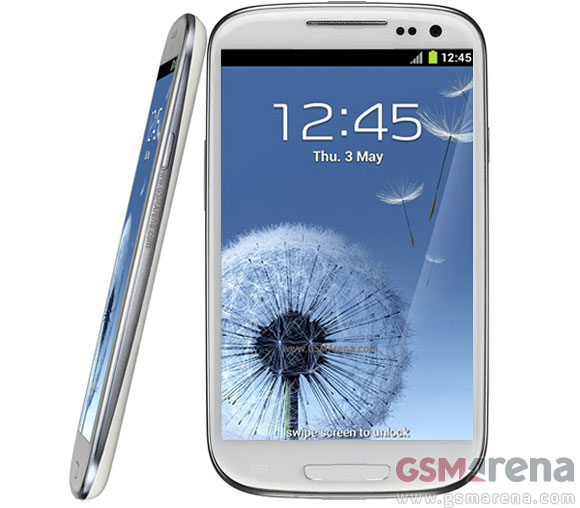
Samsung Galaxy Note 2 to sport an ultra-thin, flexible AMOLED?


Thus far, Samsung has successfully managed to keep the Galaxy Note 2 in the shadows and the only thing close to certain is its 5.5-inch AMOLED display.
KoreaTimes just came to back this claim and even went on to suggest the Samsung Galaxy Note 2 will utilize a 5.5-inch flexible AMOLED display. It's highly unlikely for the whole phone to be bendable, rather it suggests that the Note 2 will have a slight curve of some sort.
The AMOLED in question uses a Unbreakable Plane (UBP) and plastic substrate helping it reduce its thickness by 0.4mm. This may not sound like much, but on a 5.5" screen, the space saved is enough for Samsung to employ a far larger battery without making the Note 2 any thicker than its predecessor.
Samsung's Unpacked event on August 29, where the company is expected to unveil the Galaxy Note 2, is fast approaching. And if KoreaTimes's info turns out to be true, the Note 2 will make quite a stir at the IFA expo in Berlin.

Wednesday, August 8, 2012

AT&T US to launch Shared data plans come August 23rd


Owning a couple of mobile devices each of them in need of mobile data proves to be nerve-racking and overly expensive. As it happens, AT&T might allow you to put those times behind your back, as the carrier is the first to be launching shared data plans.
With data caps ranging from 1GB to 20GB, shared data plans are designed to unify your data usage under one plan, rather than having a different data subscription for every device you own. Each shared data plan requires you to sign up a smartphone, which will receive unlimited talk and text.
From there on, you can have up to 9 different devices (tablets, laptops, etc.) to share those prepaid megabytes - no need for tethering as long as your device is 3G enabled. The only nitpick is that there's an extra charge if one of those additional devices is a smartphone.
Undoubtedly, this will save you quite a hassle if you own several devices that you use interchangeably to log on to internet - such as a smartphone, a tablet and a laptop. AT&T has been kind enough to make a Mobile Share Planner tool to help you choose the best suitable plan (check source link). The carrier will launch the shared data plans on August 23.

Apple took 77% of the smartphone industry profits last quarter


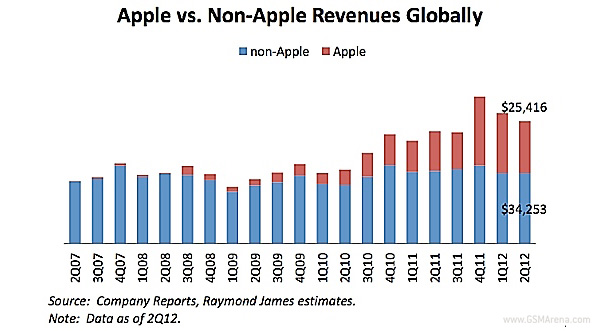
The numbers are in and once again it has been a stunning quarter for Apple. The Cupertino based company managed to reap in nearly 77 percent of the operating profits from the smartphone industry in the second fiscal quarter.
These figures are amazing because Apple only contributed to 6 percent of the industry's smartphones and tablets that were shipped last quarter and it was also supposed to be a slow quarter for Apple due to the iPhone sales being lower than usual. In comparison, Samsung shipped nearly twice as many devices in the same quarter.

So while everyone likes to point out that Android devices are outselling iOS devices, when it comes to making money off these devices, Apple is way ahead of everyone else. And these figures are only going to go up when the next iPhone and the mythical iPad mini hit the market.

Monday, August 6, 2012

Are these the nano-SIM tray and home button of the iPhone 5?


Earlier this year, lots of major phone makers fought over the design of the next generation SIM cards - known as nano-SIM - and Apple won out in the end. Photos of the alleged SIM tray for the iPhone 5 have surfaced and show the difference in size between micro- and nano-SIM, but no other changes in the design of the tray.
The nano-SIM design promises 40% smaller SIM cards, which will save room in the already crammed internals of modern smartphones. By the way, rumor has it that European carriers have already orderedlarge quantities of nano-SIM cards to get ready for the launch of the iPhone 5.
   
iPhone 5's alleged nano-SIM card tray sized up against the microSIM tray
The home button of the iPhone 5 somehow also made its way into the spy photoshoot. Its design is unchanged, but it seems that this component has shrunk too - presumably to make more room for the larger screen of the new iPhone.
 
The new home key will also be smaller
Photos supposedly of iPhone 5 components leak all the time, so take them with a pinch of salt. But if these are the genuine article, then their colors tell us something interesting - there will a black and white iPhone (not surprising), but the black one will have black sides (note the painted tray) rather than the grey metallic sides of the current design. They look like they match the leaked next-gen iPhone shells.
Source (site in French)

Windows Phone 8 might make an appearance at Nokia World


According to Bloomberg, we'll be seeing some devices introduced at Nokia World that will run on Microsoft's recently-announced Windows Phone 8 platform.
If this is true, then we might see the announcement of new WP8 devices before the rumored press conference for the next iPhone on September 12. This may not be a good thing, however, as Nokia run the risk being overshadowed by Apple's highly anticipated announcement.
As for when we'll actually see the first WP8-powered devices on the market, Microsoft have remained tight-lipped (although there are rumors of a an October release date, to coincide with their scheduled release of the Windows 8 OS). Hopefully, if announcements for Windows Phone 8 devices are made during the Nokia World conference, we'll also learn when we can get our hands on one.

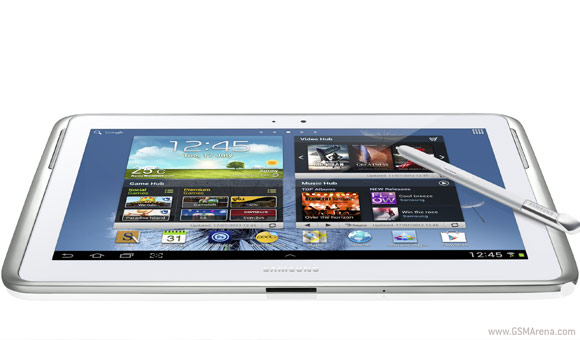
Samsung officially announces the Galaxy Note 10.1


After sending out a pretty obvious invite about its special event on August 15, Samsung has just officially announced the Galaxy Note 10.1.
This is the second appearance of the Galaxy Note 10.1 after it was returned to the R&D center for a specs update and now the tablet is as ready for action as it could be. It comes with Samsung's very own Exynos 4412 chipset with a quad-core 1.4GHz processor, Mali 400MP GPU and 2GB of RAM.
As its name suggests, the Samsung Galaxy Note 10.1 comes with 10.1" screen, which as usual for the company's slates is of the PLS TFT variety. It features a resolution of 1280x800 pixels, making for a pixel density of 149ppi.
   
Samsung Galaxy Note 10.1 official photos
The Galaxy Note 10.1 comes in 16GB, 32GB and 64GB versions, all of which feature a stylus dubbed the S Pen. This time around though, the tablet offers a slot for the S Pen, instead of making you carry it separately.
Just like the original Galaxy Note, the 10.1 comes with some exclusive apps to take advantage of the stylus, including S Note, S Planner, Crayon physics, Adobe® Photoshop® Touch, and Polaris Office. There's also palm rejection support, so you won't hit any buttons by accident with your palm when drawing with the S Pen.
The Samsung Galaxy Note 10.1 comes with a 5MP main snapper with LED flash and a 1.9MP font-facing camera for video conferencing. There's also a microSD card slot, and on the 3G models - a SIM card slot, as well.
Samsung also released a rather lengthy introductory video of the Galaxy Note 10.1 Here it is.
Offered in silver and white, the Galaxy Note 10.1 will come in three connectivity options: a WiFi-only version, a WiFi-and-3G HSPA-Plus connectivity version at launch, and a WiFi-and-LTE version later this year. The tablet is available in Korea, Germany, the US and the UK. It'll gradually be rolled-out to other global markets some time this month. European pricing is set at €479 for the Wi-Fi only version and €599 for the 3G-enabled units.
You can check out our hands-on video and live photos of the updated Samsung Galaxy Note 10.1 over here.